

Flake garage floor in South Florida
SFL Epoxy is a guide run by Terragroupe, LLC. We do not install anything and we are not booking jobs yet.
A flake garage floor is a base coat with colored flakes broadcast into it and a clear topcoat over the top. It adds pattern and texture, and it adds steps, so every layer has its own weather limits to meet. Take the Garage Floor Readiness Score to see what your floor needs first.
SFL Epoxy is a guide run by Terragroupe, LLC. We do not install anything and we are not booking jobs yet.
Last reviewed October 18, 2026 against the cited sources. A guide, not legal, tax or engineering advice.
Updated . Sources
How soon you can walk and park on it
A flake floor is a base coat, flakes and a topcoat, so its wait follows the products in your scope. Sika's polyaspartic flake system sheet gives no return-to-service times of its own and refers to the product sheets 1. Our inference is that the floor's return to service follows its last coat. That is our reading, not a statement from the sheet.
| Product and test temperature | Foot traffic | Light traffic | Full cure |
|---|---|---|---|
| Epoxy (Sikafloor-261 CA, 68 F) | about 1 day2 | about 2 days2 | about 7 days2 |
| Polyaspartic (Sikafloor-515, 68 F) | about 4 hours3 | about 8 hours3 | about 5 days3 |
| Epoxy flake coat (Sikafloor-264, 68 F) | about 12 hours4 | about 2 days4 | about 7 days4 |
| Flake last coat (Sikafloor-511, 73 F) | about 4 hours5 | about 12 hours5 | about 5 days5 |
The Sikafloor-511 row is the last coat of Sika's polyaspartic flake system 1, which uses Sikafloor-511 for both the receiver coat and the top coat 1. In Sika's epoxy flake system, Sikafloor-264 carries the flakes and a different product is the clear top coat 6. So the Sikafloor-264 row is the flake coat, not the last coat 6, and we did not read the top coat's sheet. Sika lists both systems for commercial floors such as food preparation areas and lobbies, not garages 1.
Heat shortens the waits. At 86 F the Sikafloor-264 sheet lists foot traffic after about 8 hours4, against about 12 hours4 at 68 F.
Each layer also has a recoat window. At 68 F, the Sikafloor-261 sheet lists 8 hours minimum, 48 hours maximum2, the Sikafloor-264 sheet lists 8 hours minimum, 24 hours maximum4, and the Sikafloor-515 sheet lists about 90 minutes minimum, about 24 hours maximum3. The Sikafloor-511 sheet lists a wait of about 4 hours5. A missed window means abrading before the next layer, which is why the topcoat names matter.
Ask for the base, the topcoat and the wait for cars in hours, in writing.
What a flake garage floor is and when it fits
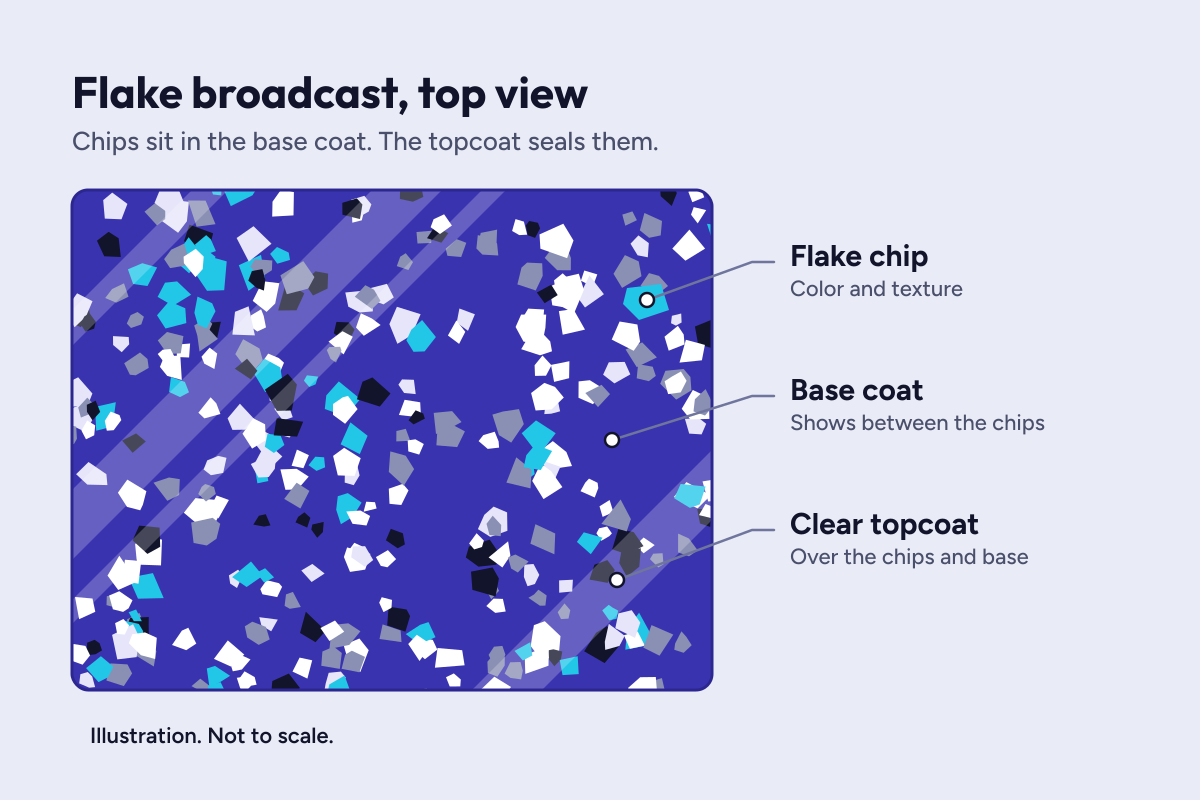
A flake floor is a layered system. A base coat goes down first. Colored flakes, also called chips, are broadcast into it while it is still wet. A clear topcoat then locks the flakes in. The base is often epoxy and the topcoat is often epoxy or polyaspartic. That is how installers commonly build it, not a rule.
People choose flakes for the look and the texture. A mix of colors can hide specks and small marks better than a plain color (our reading).
A flake floor fits when you want a patterned, textured surface and your slab passes the same prep and moisture checks as any coating. It does not fix cracks, damp concrete or oil that has soaked in. Those come first. Look at your photos for cracks, stains and water signs first, since flakes cover none of them. The readiness score is a quick start.
Flake options to ask about
- Coverage. Full broadcast fills the base with flakes until no base color shows. Partial broadcast leaves more of the base visible. Ask which one your scope names.
- Flake size and color mix. Ask to see a sample board in the light of your own garage.
- Topcoat. The topcoat decides gloss, wear and how well the flakes stay locked in (our reading). Ask which product it is and for its data sheet.
- Grip. Flakes add texture. For more grip, ask about an anti-slip additive in the topcoat. We found no friction test numbers, so we cannot rate any floor's slip resistance.
- Flake cost. This Old House lists decorative flakes at $10 per 1-lb bag 7. The number of bags depends on coverage, so ask the quote to say.
Prep and weather limits: more layers, more windows
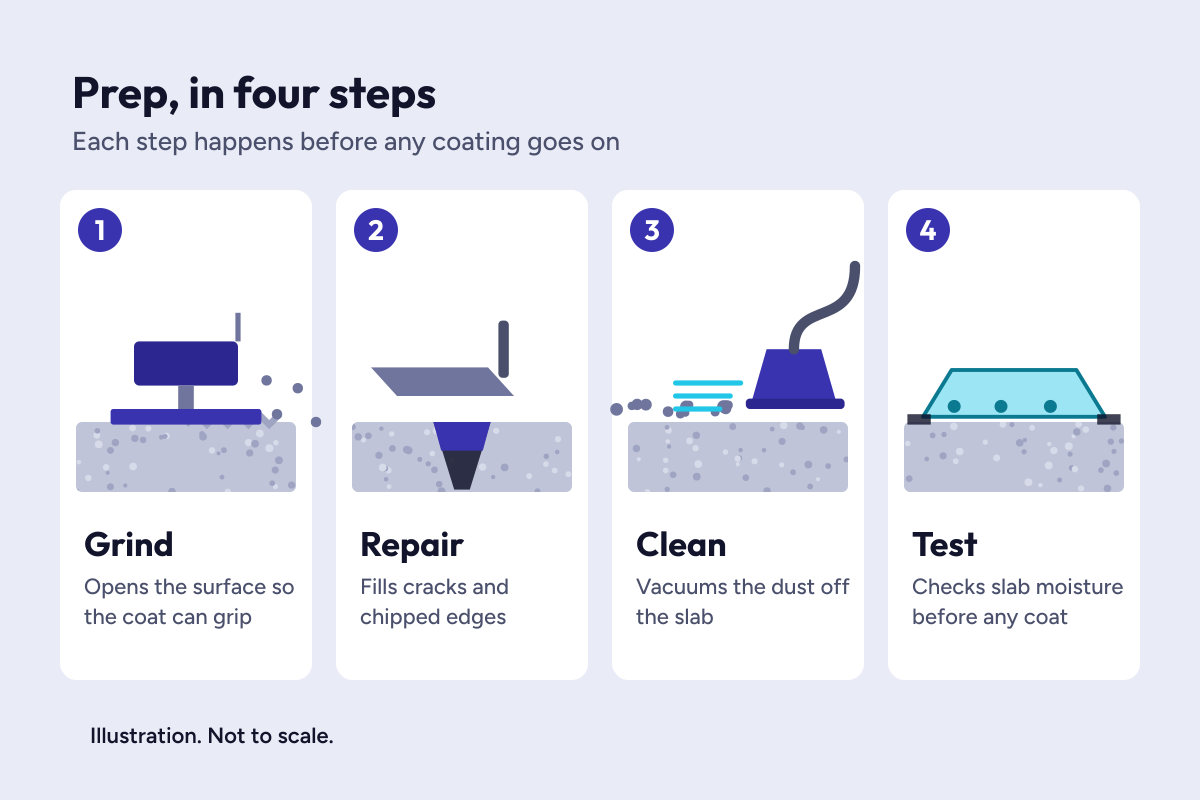
A flake job needs the prep of any coating: oil and sealers off, the surface ground or blasted open and a moisture test 3. Cracks get filled before any coat. Ground moisture can rise through a slab on the ground 8. The prep guide lists what to ask for.
Then the limits stack. The base coat has its own sheet limits and the topcoat has its own. An epoxy base sheet we read caps humidity at 85% 2. A polyaspartic topcoat sheet caps it at 75% 3. Both sheets ask the slab to stay at least 5 F above the dew point 2 3.
Flakes must go into the base while it is still wet, so the broadcast cannot wait for a better hour (our reading). More steps give more chances to miss a window. In a South Florida summer a flake job needs a clear weather plan. The guide on when to book explains early starts and dry-season windows.
How the job goes on site
These are the steps in a typical flake job. Your written scope sets the details.
- Check the slab. Start with photos, then a moisture reading and a look at cracks, old coating and drainage.
- Prep. Clean the slab, remove oil and sealers, grind or shot-blast, fill cracks and vacuum the dust.
- Check the day. Read the humidity, the slab temperature and the gap to the dew point against the base coat sheet.
- Base coat. Spread and roll it out.
- Broadcast. Throw the flakes into the wet base to the coverage in the scope.
- Clear the loose flakes. Once the base sets, sweep or scrape off what did not bond.
- Topcoat. Seal the flakes under the clear coat, inside its recoat window.
- Cure. Keep cars and wet shoes off until the scope says the floor is ready. Put that wait in hours.
- Check the result. Ask for photos of the prep and of the finished floor.
Durability and slip: what we can say
Flakes are decoration. The topcoat does the protecting. We found no independent test data on wear, hot-tire marks or impact for flake systems, so we give no ratings.
A smooth resin floor can be slick when wet. Flakes add some texture, but texture is not a slip rating. Ask what additive, if any, goes in the topcoat, and ask to step on a sample board.
A flake floor shows dirt in its texture, which can mean more brushing than a smooth floor (our reading).
What a flake floor costs: the method
Flake systems have fewer price sources than epoxy or polyaspartic. The only installed flake price we have read comes from a kit seller (vendor), which sells do-it-yourself kits. Treat it as a rough guide, not a market range. A second source will go here once we have read one.
Step 1, measure. Length times width, in feet. The sums below assume 400 sq ft, the low end of Thumbtack's two-car size 9.
Step 2, pick the rate range. The kit seller (vendor) estimates professional installation of a flake (chip) system at 5 USD per sq ft10 to 9 USD per sq ft10. That is a whole-system rate, so do not add it on top of an epoxy rate.
Step 3, multiply.
- Kit seller (vendor): 400 sq ft x 5 USD per sq ft10 and x 9 USD per sq ft10 = $2,000 to $3,600 (our arithmetic).
Step 4, add extras. A slab that tests wet may need moisture mitigation, which This Old House lists at 2 USD per sq ft11 to 10 USD per sq ft11. We found no sourced rate for grinding or crack repair.
These are national numbers, not South Florida quotes. Compare the scopes line by line. The cost guide shows more sources.
Care and cleaning
Follow the care sheet for your product. Until you have it, treat these as general habits and not a maker's rules.
- Sweep or use a soft broom to lift grit from the texture.
- Rinse and mop with a cleaner your care sheet allows.
- Wipe up fluid spills soon.
- Put pads under jack stands and heavy tool chests.
What to have in writing
Ask for these in writing:
- The flake coverage, size and color mix, with a sample board.
- The base coat and topcoat products, with their data sheets.
- The weather cut-offs for each layer.
- The wait before cars go back in.
- The warranty term and its exclusions.
We are lining up one local installer. We will publish their workmanship term here once it is signed.
How it works
The steps run from a first question to a finished floor. Nothing starts until you say yes.
- Check your floor. Take the Garage Floor Readiness Score. A short set of questions shows what to sort out first.
- Photograph your floor. Take photos of cracks, stains, old coating, drainage and garage size. They show what to fix first and what to ask an installer about.
- Ask for a written scope and a price. The scope should name the prep method, the moisture test, the system and the wait before cars go back in. The price should come in writing before any work.
- Pick a window and check the result. Choose a start day that fits the maker's weather limits. Ask for photos of the prep and of the finished floor.
What we don't handle
These jobs are outside what SFL Epoxy can help with. If your project includes one of them, we can't take the job.
- roof
- retaining wall
- slab repair
- structural
- electrical
- drain
- mold
- work sold as a water barrier
- elevated deck
- balcony
What this site gives you now
This guide cuts the guesswork. You decide from straight answers about your own slab.
- A way to size up your floor
Take the Garage Floor Readiness Score, then photograph your floor. Look for cracks, stains, old coating, drainage and garage size. They show what to fix first. - A written scope to ask for
Ask any installer for a scope that names the prep method, crack repair, moisture test and system. It should also name the wait before cars go back in. Nothing should be left to the day. - A price to compare
Ask to see the price in writing before work starts. Set it next to the labeled ranges on this site, so you can judge it. Nothing should start until you say yes. - A timing guide
Dry-season and early-morning windows, read against the maker's limits. The coat goes down when the weather allows it. - A warranty checklist
Ask for the written exclusions before you sign. Moisture, hot-tire marks, impact and fluids are the ones to ask about. - A permit and HOA one-pager
The office to call, the page to read and the papers to check for your city. Nothing should surprise you. - A photo habit
Take photos of the prep and of the finished floor, so you can see the result. - What to ask for in writing
Ask any installer to put the workmanship term in your written scope. We will publish an installer's term on this site if one signs.
This site is free to read. It sells no work and takes no payment. If your slab is not a fit for a coating, the score and the guides point that out. Any work is agreed in writing between you and the installer who does it.
Garage Floor Readiness Score
Answer each question. The score shows how much needs sorting out before a coating, and which answers added the most. It is a starting point, not a price or a promise.
Start the Garage Floor Readiness ScoreSFL Epoxy is a guide run by Terragroupe, LLC. We do not install anything and we are not booking jobs yet.
National price ranges for flake garage floor
| Job | Range | Source |
|---|---|---|
| National range, not a Florida or local quote. Low end of a kit seller's estimate for professional installation of a flake (chip) epoxy system, per square foot (vendor).Vendor estimate from a company that sells do-it-yourself kits, and the only flake price we have read. | 5 USD per sq ft | [10]National price guide range, Epoxy Flooring Cost Per Sq Ft: 2026 DIY vs Installed Prices (ArmorGarage blog, vendor), September 2026 |
| National range, not a Florida or local quote. High end of a kit seller's estimate for professional installation of a flake (chip) epoxy system, per square foot (vendor).Vendor estimate from a company that sells do-it-yourself kits, and the only flake price we have read. | 9 USD per sq ft | [10]National price guide range, Epoxy Flooring Cost Per Sq Ft: 2026 DIY vs Installed Prices (ArmorGarage blog, vendor), September 2026 |
| National range, not a Florida or local quote. Low end of the extra cost for a vapor barrier or moisture-mitigation system on a garage floor project, per square foot. | 2 USD per sq ft | [11]National price guide range, Garage Floor Replacement Cost (2026 Pricing) (This Old House), April 2026 |
| National range, not a Florida or local quote. High end of the extra cost for a vapor barrier or moisture-mitigation system on a garage floor project, per square foot. | 10 USD per sq ft | [11]National price guide range, Garage Floor Replacement Cost (2026 Pricing) (This Old House), April 2026 |
Flake garage floor in South Florida: cities
Other services
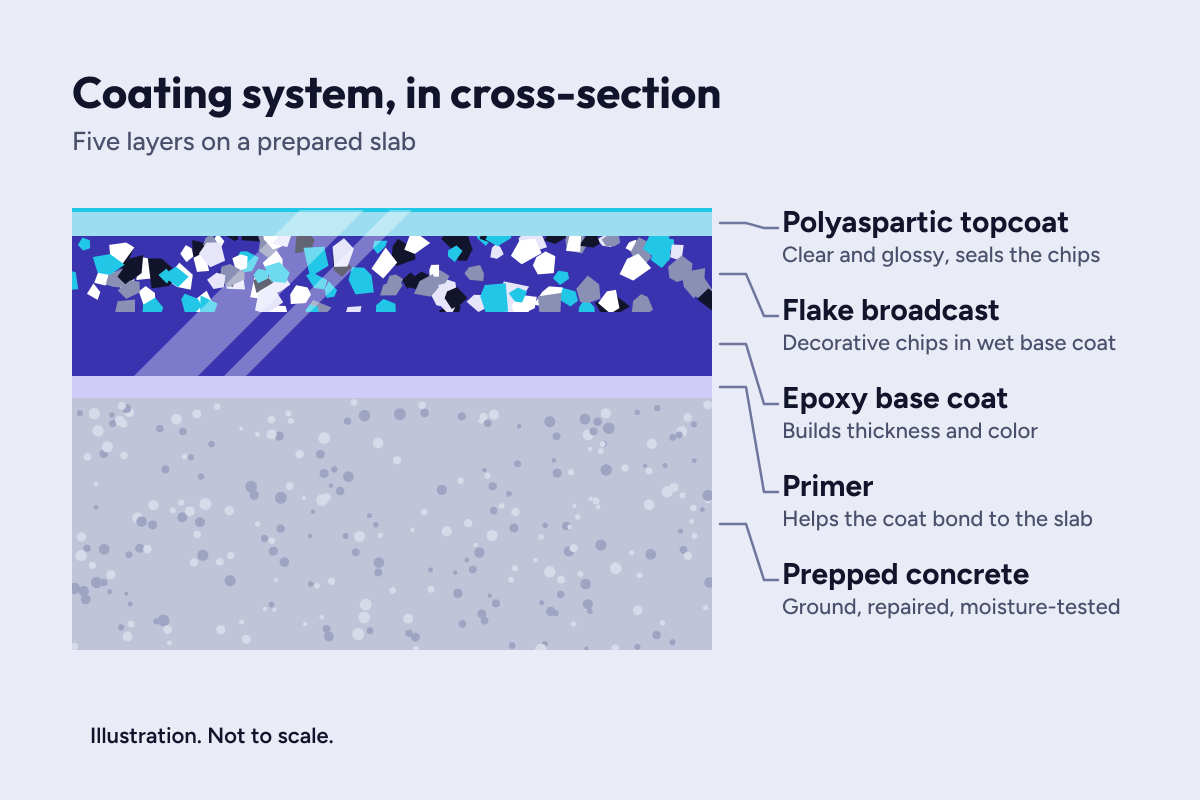
Illustration Epoxy garage floor
A resin and hardener coat that bonds to a ground, tested slab. It is also the base layer in many flake and hybrid systems.
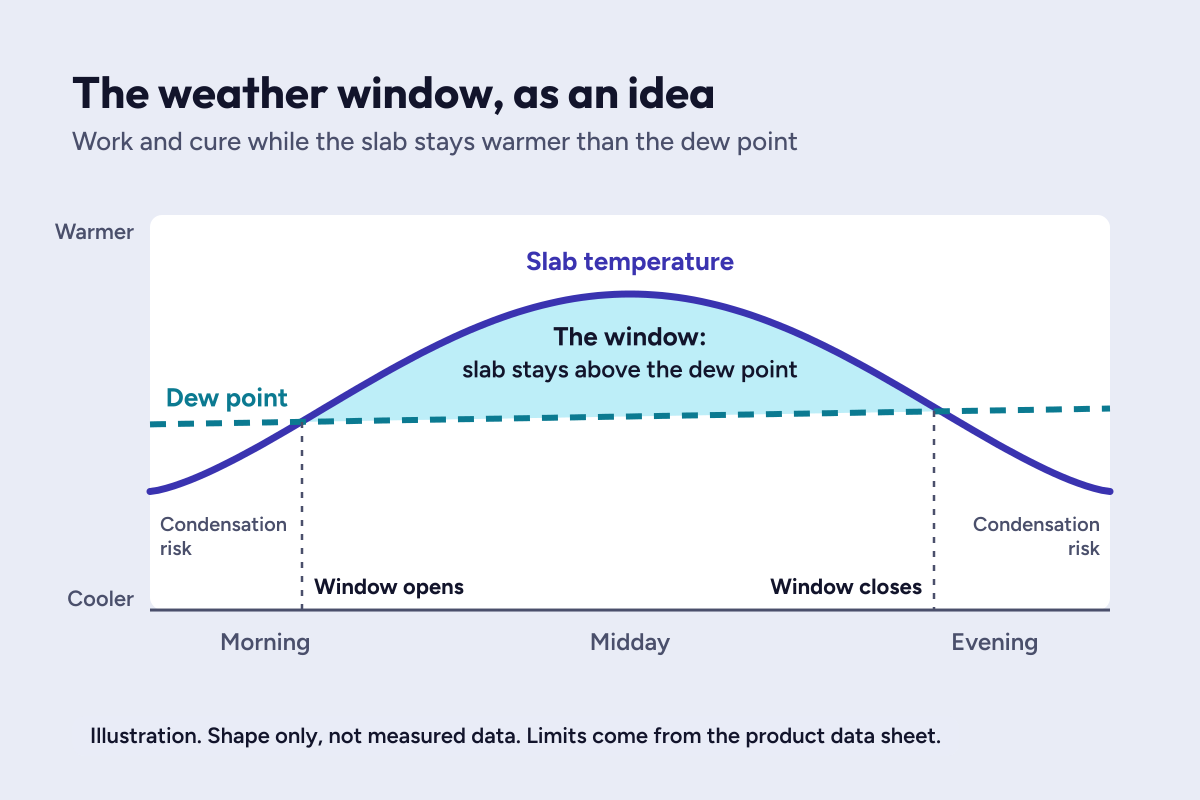
Illustration Polyaspartic garage floor
A fast-curing coat, often used as a clear topcoat. It brings a tighter humidity cap and a short recoat window.
Guides
Evidence: the facts and sources behind this page
Flake garage floor: facts behind this page
As of October 18, 2026
| Fact | Value | Source |
|---|---|---|
| Polyaspartic topcoat data sheet requires substrate at least 5 F above dew point and max ambient RH of 75% during application and curing. | 5 F margin; RH <= 75 F / percent RH | [3] June 10, 2021 |
| Epoxy smooth-finish coating data sheet: max RH 85% during application and cure; substrate at least 5 F (3 C) above dew point; substrate 50-86 F; concrete moisture <= 4% by Tramex meter; no vehicle load until fully cured. | RH <= 85; moisture <= 4; substrate 50-86 percent RH / percent by mass / F | [2] 2026-06 |
| Polyaspartic topcoat at 68 F: foot traffic ~4 h, light traffic ~8 h, full cure ~5 days; marketed for enhanced hot-tire-marking resistance and excellent UV resistance. | 4 h / 8 h / 5 days hours / days | [3] June 10, 2021 |
| Garage-market polyaspartic base coat data sheet: apply 30-90 F, tack-free 2-4 h, vehicles after 24 h at 72 F / 50% RH, recoat 2-12 h, UV stable. | vehicles 24 h hours | [12] 2025 (Version 1; Rev 11/21) |
| Ground moisture can move up through slab-on-grade concrete; a plastic sheet directly under the slab is the recommended barrier, and Building Science argues Florida slabs fare better than California's because of that practice. | n/a | [8] May 26, 2008 |
| Florida s. 489.117(4)(a) lists painting and flooring among scopes that do not require a contractor license (list is non-exhaustive). | no state contractor license for flooring scope | [13] 2026 |
Sources
- Sikafloor DecoDur Flake FS system data sheet (Sika USA, April 2024, vendor), 2024-04
- Sikafloor-261 CA Product Data Sheet (fiche technique), 2026-06
- Sikafloor-515 Product Data Sheet, June 10, 2021
- Sikafloor-264 Product Data Sheet (Sika USA, September 2026, Version 08.05), 2026-09
- Sikafloor-511 Product Data Sheet (Sika USA, June 2023, Version 01.09), 2023-06
- Sikafloor DecoDur Flake FX system data sheet (Sika USA, May 2026, vendor), 2026-05
- This Old House, How Much Does Epoxy Flooring Cost?, March 13, 2026
- Building Science Corporation, BSI-003 Concrete Floor Problems (Lstiburek), May 26, 2008
- Thumbtack, 2026 Epoxy Garage Floor Cost, July 1, 2026
- Epoxy Flooring Cost Per Sq Ft: 2026 DIY vs Installed Prices (ArmorGarage blog, vendor), September 22, 2026
- Garage Floor Replacement Cost (2026 Pricing) (This Old House), April 15, 2026
- ArmorGarage Polyaspartic Floor System TDS (ArmorPoly 80), 2025 (Version 1; Rev 11/21)
- Online Sunshine, Florida Statutes: s. 489.117, 2026
Questions people ask
Is a flake garage floor slippery?
A smooth resin floor can be slick when wet. Flakes add some texture. We found no friction test numbers, so we cannot rate any floor. Ask about an anti-slip additive in the topcoat and ask to step on a sample board.
How much does a flake garage floor cost?
The only installed flake price we have read is a kit seller's estimate (vendor) of 5 USD per sq ft10 to 9 USD per sq ft10. It is a national number and not a South Florida quote. Your price depends on prep, coverage and the topcoat.
Can flakes hide cracks or stains in the slab?
No. Flakes sit on the surface. A crack can show through or reopen, and oil that soaked in can interfere with the bond. Both are prep jobs that come before any coat.
Flake or a solid color: which should I pick?
A solid color is simpler. A flake floor adds a pattern and some texture, and it adds the broadcast and topcoat steps, each with its own weather window. Pick by look, and by how much weather risk you want to carry.
Can I add flakes to a polyaspartic floor?
Flakes go into the base coat, and the topcoat can be epoxy or polyaspartic. Ask what base and what topcoat are in your scope, and read the sheet for each. The polyaspartic page covers that topcoat's limits.