

Polyaspartic garage floor in South Florida
SFL Epoxy is a guide run by Terragroupe, LLC. We do not install anything and we are not booking jobs yet.
Polyaspartic is a fast-curing coating, often used as a clear topcoat over an epoxy or polyurea base in a hybrid system. Its sheet sets a tighter humidity cap and a short recoat window, so the start day matters more than the product name 1. Take the Garage Floor Readiness Score to see what your floor needs first.
SFL Epoxy is a guide run by Terragroupe, LLC. We do not install anything and we are not booking jobs yet.
Last reviewed October 18, 2026 against the cited sources. A guide, not legal, tax or engineering advice.
Updated . Sources
How soon you can walk and park on it
The Sikafloor-515 polyaspartic topcoat data sheet (June 2021 version) lists foot traffic after about 4 hours1 at 68 F, light traffic after about 8 hours1 and full cure after about 5 days1. A garage-market base coat sheet, ArmorPoly 80, lists a tack-free time of 2 to 4 hours2 and vehicle traffic after 24 hours2, at 72 F and 50% humidity.
| Product and test conditions | Foot traffic or tack-free | Light traffic or vehicles | Full cure | Recoat window | Humidity and dew point |
|---|---|---|---|---|---|
| Sikafloor-515 topcoat, 68 F | about 4 hours1 | about 8 hours1 | about 5 days1 | about 90 minutes minimum, about 24 hours maximum1 | 75% humidity at most; slab at least 5 F above dew point1 |
| ArmorPoly 80 base, 72 F, 50% RH | 2 to 4 hours2 | after 24 hours2 | Not read yet | 2 to 12 hours2 | Not read yet |
These are the makers' figures (vendor data), from different products. They are not a head-to-head test, and temperature and humidity move them. Put the wait for cars in hours in your written scope.
What a polyaspartic garage floor is and when it fits
Polyaspartic is a fast-curing coating. It is often sold as a clear topcoat over a base coat of epoxy or polyurea. That mix is called a hybrid system. Ads use polyaspartic and polyurea as near-synonyms, so ask for the product name and its data sheet.
A fast cure is the main reason people choose it. One topcoat sheet lists about 4 h to foot traffic and about 5 days to full cure at 68 F 1. A garage-market base coat sheet lists vehicles back after 24 h at 72 F and 50% humidity 2.
It fits when you want the garage back soon, or when your weather window is short. It fits poorly when the slab is damp, because the same moisture limit applies, or when a tight schedule is hard to keep. The readiness score is a quick way to see where you stand.
Prep: the same slab rules with less time to fix mistakes
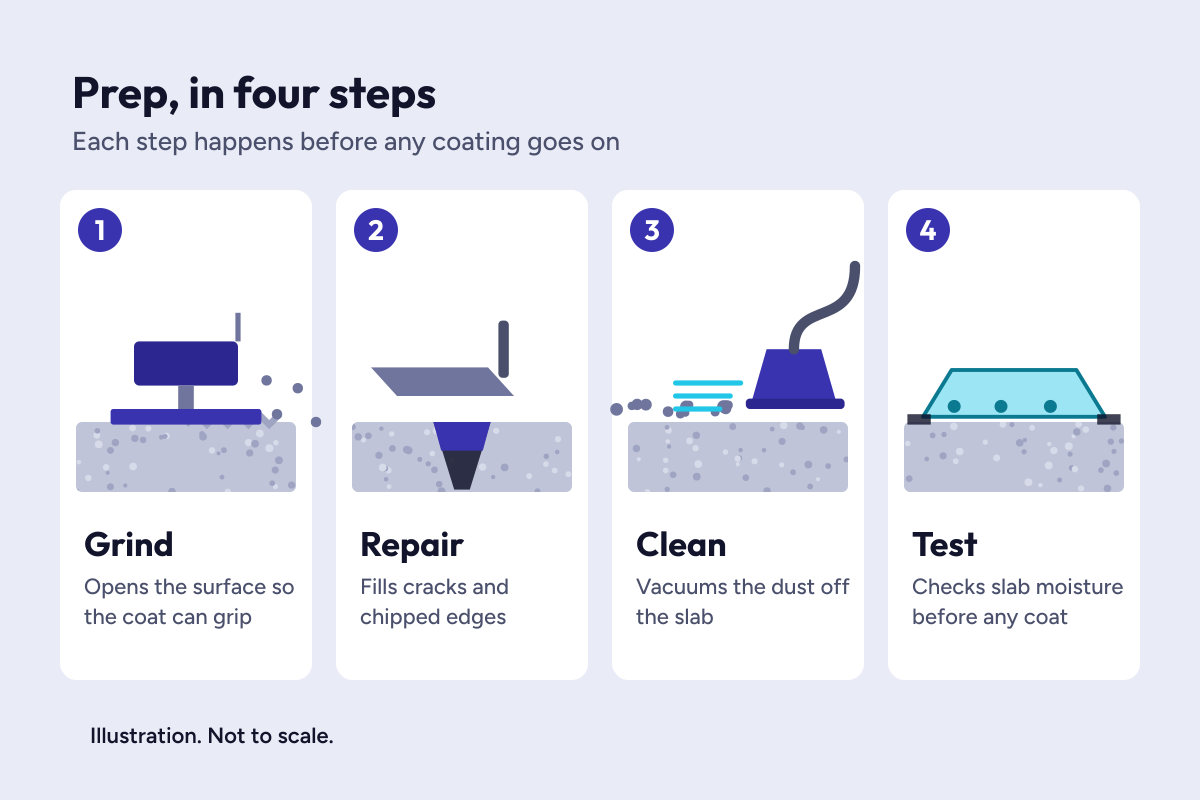
Polyaspartic needs the same clean, rough, dry slab as epoxy. The topcoat sheet calls for shot-blasting to a concrete surface profile (CSP) of 3 to 4 1. It also caps slab moisture at 4% on a Tramex meter 1.
A fast-curing coat leaves little time to fix a mistake. Cracks, dust and old sealer have to be dealt with before the first coat and not during it (our reading). Ground moisture can rise through a slab on the ground, so the moisture test is not optional 3.
The prep guide lists what to ask for in writing.
Humidity and dew point: a tighter window
The limits below come from the polyaspartic sheets we read. They are the makers' numbers (vendor data), not independent tests.
- Air humidity: no higher than 75% during the work and the cure 1.
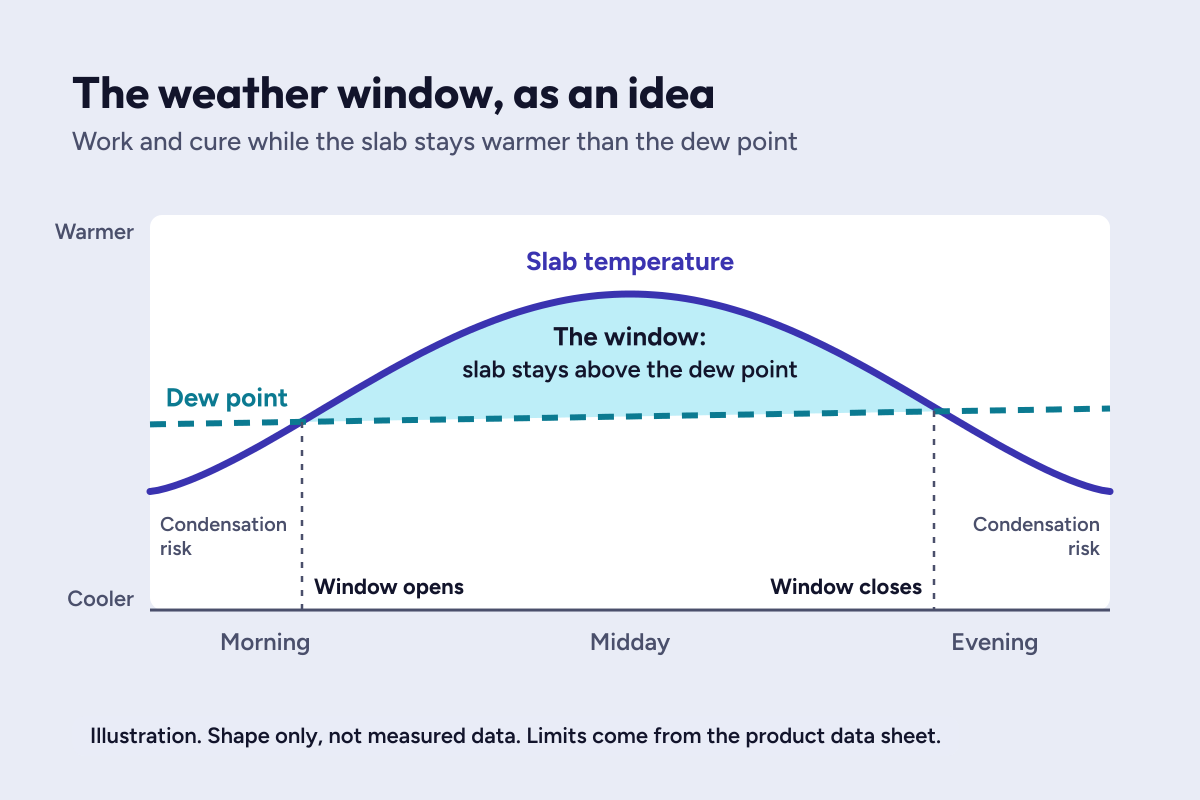
- Dew point: the slab must stay at least 5 F above it 1.
- Slab moisture: 4% or less on a Tramex meter 1.
- Temperature: the garage-market base coat sheet allows application from 30 F to 90 F 2.
- Recoat: that base coat sheet lists a window of 2 h to 12 h 2.
The epoxy sheet we read allows humidity up to 85% 4, so the polyaspartic cap is tighter. On a South Florida summer morning that can make a day that fits epoxy too humid for polyaspartic (our reading, based on the sheets).
The recoat window is short. A hybrid system can need its next layer within hours, and a storm or a muggy morning can end the day. Ask for a fallback date and for who pays for a return trip. The city pages set NOAA dew point normals next to this margin 1, for Miami and West Palm Beach. Airport air is not your slab, so the reading in your garage decides.
How the job goes on site
These are the steps in a typical hybrid job. Your written scope sets the details.
- Check the slab. Start with photos, then a moisture reading and a look at cracks, old coating and drainage.
- Prep. Shot-blast or grind to the profile the sheet names, fill cracks and vacuum the dust.
- Check the day. Read the humidity, the slab temperature and the gap to the dew point against the polyaspartic limits, not the epoxy ones.
- Base coat. It is usually epoxy or polyurea, spread and rolled out. Ask which one.
- Topcoat. The clear polyaspartic layer goes on inside the recoat window.
- Cure. Foot traffic comes first, then light use, then cars. The sheets list those waits at set temperatures 1 2. Your garage will not match the test conditions, so the wait for cars goes in your scope, in hours.
- Check the result. Ask for photos of the prep and of the finished floor.
Durability: what is claimed and what is tested
Makers market polyaspartic topcoats for hot-tire marking resistance and UV stability 1. One garage-market sheet also calls its base coat UV stable 2. We found no independent test of either claim.
An installer blog says polyaspartic holds up better in Florida heat, humidity and UV 5. The post is promotional and gives no test data or failure rates, so we treat it as a claim.
A fast cure is a fact on the sheets. A longer life is not shown. Ask what the warranty says about hot-tire marks, impact and fluids.
What a polyaspartic floor costs: the method
Price is floor area times a rate per square foot, plus extras. The rates below are national ranges, not South Florida quotes. A hybrid system has a base and a topcoat, so ask what each layer costs.
Step 1, measure. Length times width, in feet. The sums below assume 400 sq ft, the low end of Thumbtack's two-car size 6.
Step 2, pick a rate range. A kit seller (vendor) estimates professional installs at 7 USD per sq ft7 to 12 USD per sq ft7. It sells do-it-yourself kits, so it is not an independent guide. We found no recent independent guide that prices polyaspartic per square foot, so this is the only rate shown.
Step 3, multiply the area by each rate.
- Kit seller (vendor): 400 sq ft x 7 USD per sq ft7 and x 12 USD per sq ft7 = $2,800 to $4,800 (our arithmetic).
Step 4, add extras. A slab that tests wet may need moisture mitigation, which This Old House lists at 2 USD per sq ft8 to 10 USD per sq ft8. We found no sourced rate for grinding or crack repair.
The epoxy and polyaspartic ranges overlap, so price alone does not decide the choice. Compare the scopes line by line. The cost guide shows more sources.
Care and cleaning
Follow the care sheet for your product. Until you have it, treat these as general habits and not a maker's rules.
- Blow or sweep off loose grit before you wash.
- Skip abrasive pads and harsh solvents unless the care sheet allows them.
- Clean up fluid spills soon.
- Do not drag heavy items across the floor.
What to have in writing
Ask for these in writing:
- The product in each layer, with its data sheet.
- The recoat window, the fallback date and who pays for a return trip.
- The humidity and dew point cut-offs for a start.
- The wait before cars go back in.
- The warranty term and its exclusions.
We are lining up one local installer. We will publish their workmanship term here once it is signed.
How it works
The steps run from a first question to a finished floor. Nothing starts until you say yes.
- Check your floor. Take the Garage Floor Readiness Score. A short set of questions shows what to sort out first.
- Photograph your floor. Take photos of cracks, stains, old coating, drainage and garage size. They show what to fix first and what to ask an installer about.
- Ask for a written scope and a price. The scope should name the prep method, the moisture test, the system and the wait before cars go back in. The price should come in writing before any work.
- Pick a window and check the result. Choose a start day that fits the maker's weather limits. Ask for photos of the prep and of the finished floor.
What we don't handle
These jobs are outside what SFL Epoxy can help with. If your project includes one of them, we can't take the job.
- roof
- retaining wall
- slab repair
- structural
- electrical
- drain
- mold
- work sold as a water barrier
- elevated deck
- balcony
What this site gives you now
This guide cuts the guesswork. You decide from straight answers about your own slab.
- A way to size up your floor
Take the Garage Floor Readiness Score, then photograph your floor. Look for cracks, stains, old coating, drainage and garage size. They show what to fix first. - A written scope to ask for
Ask any installer for a scope that names the prep method, crack repair, moisture test and system. It should also name the wait before cars go back in. Nothing should be left to the day. - A price to compare
Ask to see the price in writing before work starts. Set it next to the labeled ranges on this site, so you can judge it. Nothing should start until you say yes. - A timing guide
Dry-season and early-morning windows, read against the maker's limits. The coat goes down when the weather allows it. - A warranty checklist
Ask for the written exclusions before you sign. Moisture, hot-tire marks, impact and fluids are the ones to ask about. - A permit and HOA one-pager
The office to call, the page to read and the papers to check for your city. Nothing should surprise you. - A photo habit
Take photos of the prep and of the finished floor, so you can see the result. - What to ask for in writing
Ask any installer to put the workmanship term in your written scope. We will publish an installer's term on this site if one signs.
This site is free to read. It sells no work and takes no payment. If your slab is not a fit for a coating, the score and the guides point that out. Any work is agreed in writing between you and the installer who does it.
Garage Floor Readiness Score
Answer each question. The score shows how much needs sorting out before a coating, and which answers added the most. It is a starting point, not a price or a promise.
Start the Garage Floor Readiness ScoreSFL Epoxy is a guide run by Terragroupe, LLC. We do not install anything and we are not booking jobs yet.
National price ranges for polyaspartic garage floor
| Job | Range | Source |
|---|---|---|
| Our arithmetic for a 400-500 sq ft two-car garage, national ranges from sources we read: epoxy about $1,200 to $6,000 (This Old House $3 to $12 per sq ft x 400 to 500 sq ft; Thumbtack typical about $2,370); polyaspartic about $2,800 to $6,000 (a kit seller's, vendor, $7 to $12 per sq ft x 400 sq ft low and 500 sq ft high).National ranges from price guides, not local quotes; prep, cracks and system thickness move the price. | epoxy 1200-6000; polyaspartic 2800-6000 USD | [6]National price guide range, 2026 Epoxy Garage Floor Cost | Get Estimates, October 2026 |
| National range, not a Florida or local quote. Low end of a kit seller's estimate for a professionally installed polyaspartic coating, per square foot (vendor).Vendor estimate from a company that sells do-it-yourself kits, not an independent price guide. | 7 USD per sq ft | [7]National price guide range, Epoxy Flooring Cost Per Sq Ft: 2026 DIY vs Installed Prices (ArmorGarage blog, vendor), September 2026 |
| National range, not a Florida or local quote. High end of a kit seller's estimate for a professionally installed polyaspartic coating, per square foot (vendor).Vendor estimate from a company that sells do-it-yourself kits, not an independent price guide. | 12 USD per sq ft | [7]National price guide range, Epoxy Flooring Cost Per Sq Ft: 2026 DIY vs Installed Prices (ArmorGarage blog, vendor), September 2026 |
| National range, not a Florida or local quote. Low end of the extra cost for a vapor barrier or moisture-mitigation system on a garage floor project, per square foot. | 2 USD per sq ft | [8]National price guide range, Garage Floor Replacement Cost (2026 Pricing) (This Old House), April 2026 |
| National range, not a Florida or local quote. High end of the extra cost for a vapor barrier or moisture-mitigation system on a garage floor project, per square foot. | 10 USD per sq ft | [8]National price guide range, Garage Floor Replacement Cost (2026 Pricing) (This Old House), April 2026 |
Polyaspartic garage floor in South Florida: cities
Other services
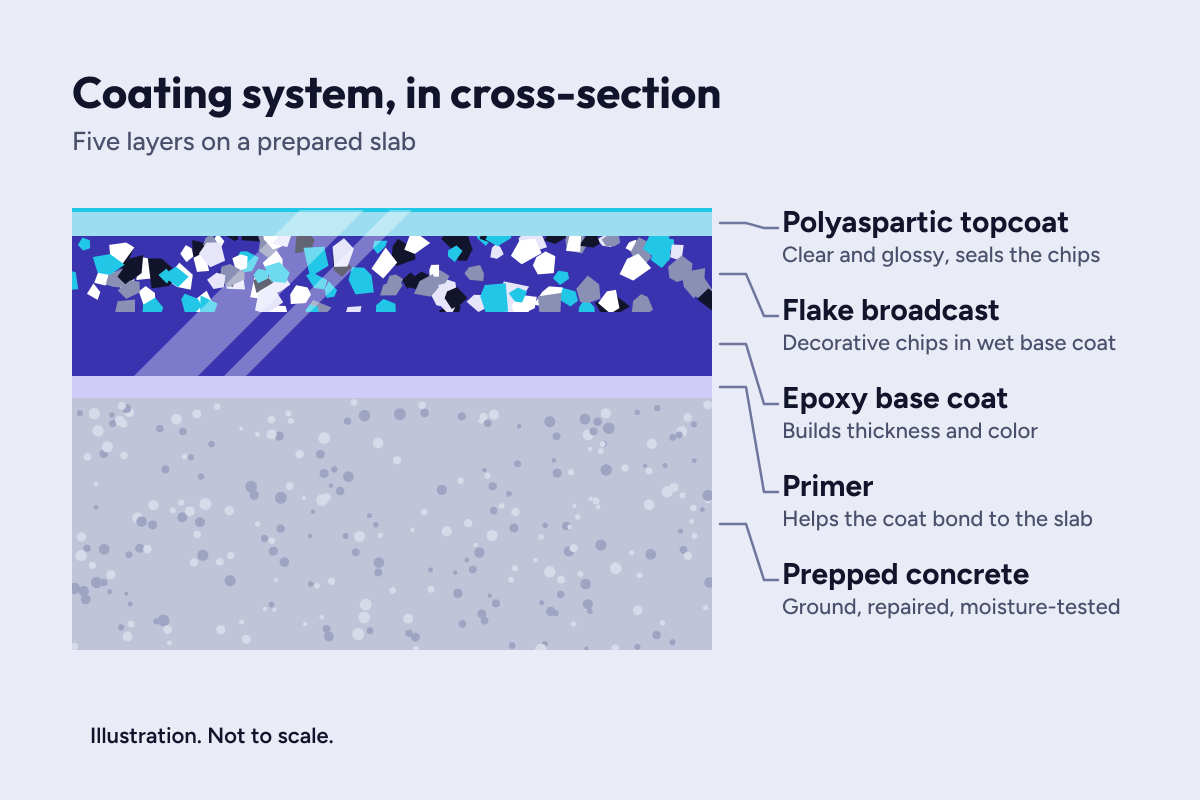
Illustration Epoxy garage floor
A resin and hardener coat that bonds to a ground, tested slab. It is also the base layer in many flake and hybrid systems.
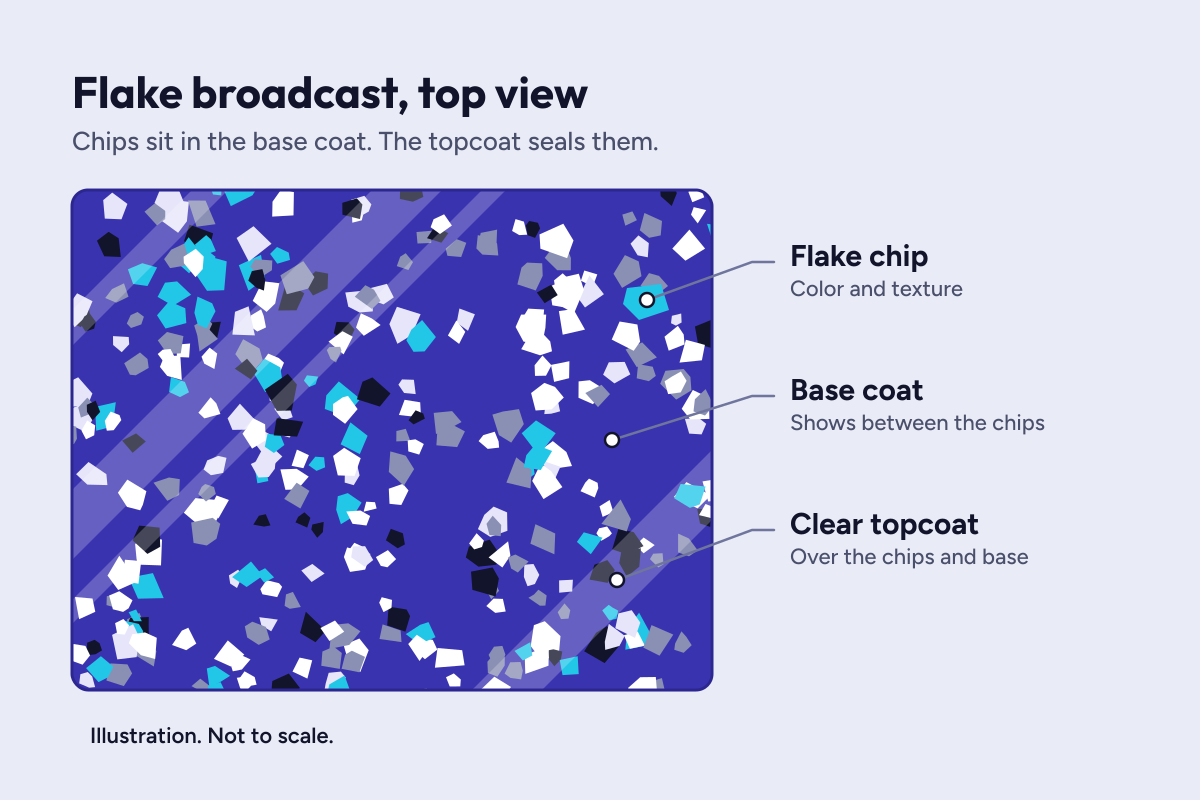
Illustration Flake garage floor
A base coat with colored flakes locked under a clear topcoat. It adds texture and a pattern, and a few more steps.
Guides
Evidence: the facts and sources behind this page
Polyaspartic garage floor: facts behind this page
As of October 18, 2026
| Fact | Value | Source |
|---|---|---|
| Polyaspartic topcoat data sheet requires substrate at least 5 F above dew point and max ambient RH of 75% during application and curing. | 5 F margin; RH <= 75 F / percent RH | [1] June 10, 2021 |
| Epoxy smooth-finish coating data sheet: max RH 85% during application and cure; substrate at least 5 F (3 C) above dew point; substrate 50-86 F; concrete moisture <= 4% by Tramex meter; no vehicle load until fully cured. | RH <= 85; moisture <= 4; substrate 50-86 percent RH / percent by mass / F | [4] 2026-06 |
| Polyaspartic topcoat at 68 F: foot traffic ~4 h, light traffic ~8 h, full cure ~5 days; marketed for enhanced hot-tire-marking resistance and excellent UV resistance. | 4 h / 8 h / 5 days hours / days | [1] June 10, 2021 |
| Garage-market polyaspartic base coat data sheet: apply 30-90 F, tack-free 2-4 h, vehicles after 24 h at 72 F / 50% RH, recoat 2-12 h, UV stable. | vehicles 24 h hours | [2] 2025 (Version 1; Rev 11/21) |
| Ground moisture can move up through slab-on-grade concrete; a plastic sheet directly under the slab is the recommended barrier, and Building Science argues Florida slabs fare better than California's because of that practice. | n/a | [3] May 26, 2008 |
| Florida s. 489.117(4)(a) lists painting and flooring among scopes that do not require a contractor license (list is non-exhaustive). | no state contractor license for flooring scope | [10] 2026 |
Sources
- Sikafloor-515 polyaspartic topcoat data sheet (manufacturer), June 10, 2021
- ArmorGarage Polyaspartic Floor System TDS (ArmorPoly 80), 2025 (Version 1; Rev 11/21)
- Building Science Corporation, BSI-003 Concrete Floor Problems (Lstiburek), May 26, 2008
- Sikafloor-261 CA product data sheet (manufacturer, Canadian edition), 2026-06
- Installer blog on epoxy and polyaspartic in Florida (promotional, no test data), June 15, 2026
- Thumbtack, 2026 Epoxy Garage Floor Cost, July 1, 2026
- Epoxy Flooring Cost Per Sq Ft: 2026 DIY vs Installed Prices (ArmorGarage blog, vendor), September 22, 2026
- Garage Floor Replacement Cost (2026 Pricing) (This Old House), April 15, 2026
- How Much Does Epoxy Flooring Cost?, March 13, 2026
- Online Sunshine, Florida Statutes: s. 489.117, 2026
Questions people ask
Is polyaspartic worth it for a Florida garage?
That depends on what you value. A fast return to service is on the data sheets 1. Longer life and hot-tire resistance are vendor claims with no independent tests. Compare the written scope and the warranty for each system.
Is polyaspartic the same as polyurea?
The words overlap in ads, so do not assume they match. Ask for the product name and the data sheet for each layer, and ask what the base coat is made of.
How soon can I drive on polyaspartic?
At 68 F the topcoat sheet lists about 4 h for foot traffic and about 5 days to full cure 1. A garage-market sheet lists vehicles after 24 h at 72 F and 50% humidity 2. Put the wait for cars in your scope, in hours.
Does polyaspartic cost more than epoxy?
National guides show epoxy at 3-12 USD per sq ft9 and a kit seller (vendor) estimates polyaspartic at 7 USD per sq ft7 to 12 USD per sq ft7. The ranges overlap. They are national numbers and not South Florida quotes.
Can polyaspartic go on in a Florida summer?
Only on a day that fits the sheet: humidity no higher than 75% and a slab at least 5 F above the dew point 1. Those days are fewer in a South Florida summer (our reading). The guide on when to book explains early starts and dry-season windows.