

Epoxy garage floor in South Florida
SFL Epoxy is a guide run by Terragroupe, LLC. We do not install anything and we are not booking jobs yet.
An epoxy garage floor is a resin and hardener coat that bonds to concrete you have ground, repaired and tested for moisture. It fits a sound, dry slab and a start day inside the maker's humidity and dew point limits 1. Take the Garage Floor Readiness Score to see what your floor needs first.
SFL Epoxy is a guide run by Terragroupe, LLC. We do not install anything and we are not booking jobs yet.
Last reviewed October 18, 2026 against the cited sources. A guide, not legal, tax or engineering advice.
Updated . Sources
How soon you can walk and park on it
The Sikafloor-261 CA epoxy data sheet (June 2026 edition) lists foot traffic after about 1 day1 at 68 F, light traffic after about 2 days1 and full cure after about 7 days1. At 86 F it lists about 18 hours1 for foot traffic and about 5 days1 for full cure.
| Slab and air temperature | Foot traffic | Light traffic | Full cure | Recoat window |
|---|---|---|---|---|
| 68 F (20 C) | about 1 day1 | about 2 days1 | about 7 days1 | 8 hours minimum, 48 hours maximum1 |
| 86 F (30 C) | about 18 hours1 | about 2 days1 | about 5 days1 | 6 hours minimum, 24 hours maximum1 |
The sheet also sets the conditions for the work and the cure: 85% humidity at most; slab at least 5 F above dew point1. It asks for readings at at least every 3 hours1.
The sheet lists light traffic, not cars. It says the coat reaches its full properties only when it has fully cured. Ask the installer to put the wait for cars in hours, in your written scope.
What an epoxy garage floor is and when it fits
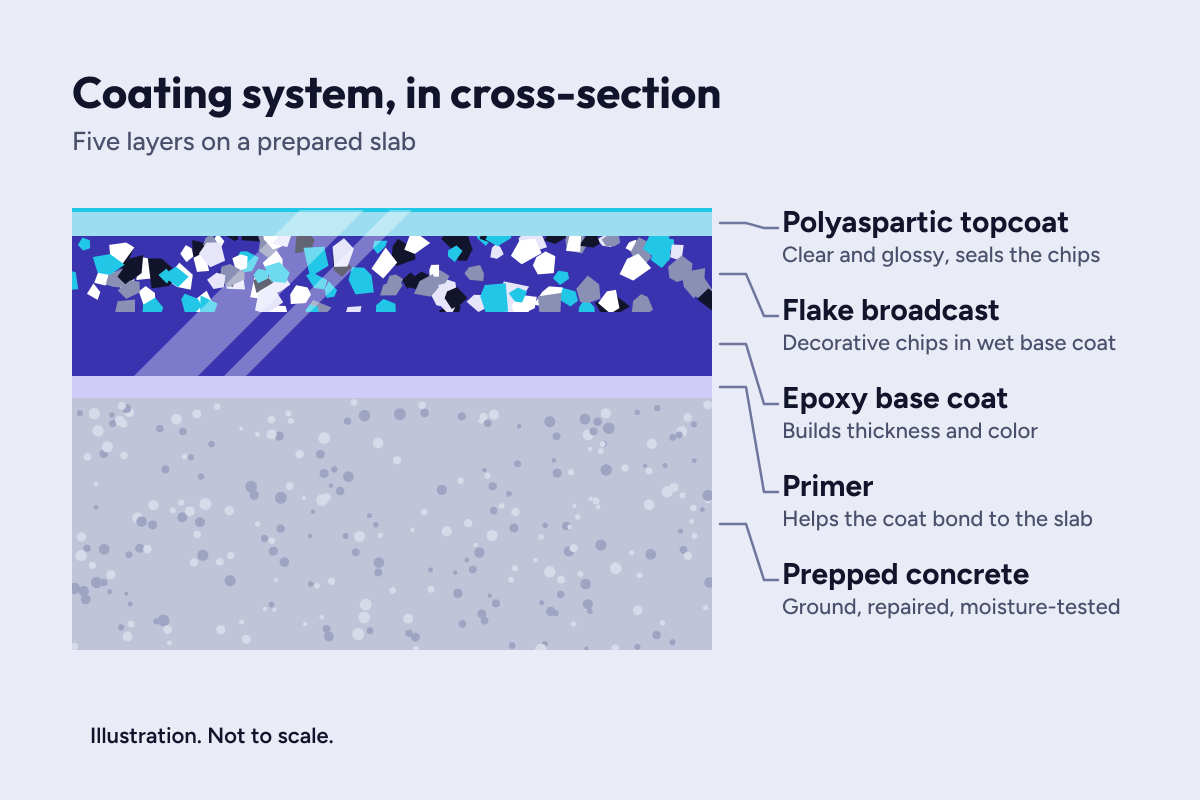
Epoxy is a resin that you mix with a hardener. It cures into a hard film on top of the slab. It is sold as a plain color, as a clear coat over a color, and as the base layer under flakes or a polyaspartic topcoat.
It is a coating, not a repair. It does not fix a slab that is wet, sinking or splitting. The slab has to be sound before the coat goes on.
It fits when you own the garage slab, the concrete tests dry and you can wait for a good weather day. It fits poorly when water keeps rising through the slab, when a crack keeps moving, or when an association must approve the change first. The readiness score shows which of these apply to you.
Prep before the coat
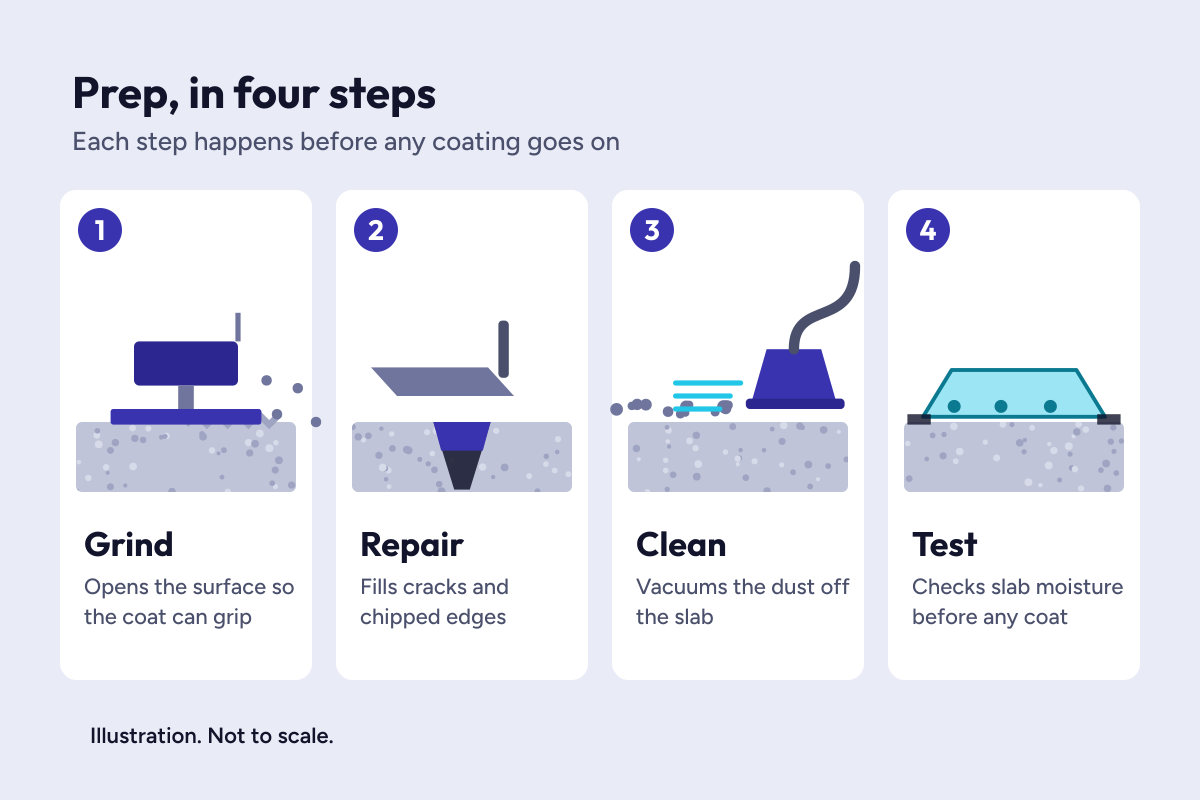
A coat grips only what is clean and rough. The data sheets we read call for removing oil and sealers, then grinding or shot-blasting to open the surface 2. Cracks, chips and spalled spots get filled first, because a coat shows a crack through it.
Then the slab gets a moisture test. The epoxy sheet we read caps slab moisture at 4% on a Tramex meter 1. A slab that fails needs another plan before epoxy goes on. Ground moisture can rise through a slab on the ground, and you cannot see the barrier under it 3.
The prep guide lists what to ask for in writing.
Humidity and dew point: the limits to check
An epoxy coat is sensitive to the air and to the slab, both while it goes down and while it cures. One smooth-finish epoxy sheet sets the limits below. They are the maker's numbers (vendor data), not independent tests 1.
- Air humidity: no higher than 85% during the work and the cure 1.
- Slab temperature: 50 F to 86 F 1.
- Dew point: the slab must stay at least 5 F above it 1.
- Slab moisture: 4% or less on a Tramex meter 1.
- Recoat: the window runs from about 8 h at 68 F to 48 h, then the surface needs abrading 1.
Dew point is the temperature at which water starts to form on a surface. When the slab sits close to it, moisture can form under a wet coat. South Florida summers are hot and humid, so the margin can shrink (our reading, not a measured failure rate).
The city pages set NOAA airport normals next to these limits, for Miami and West Palm Beach. Airport air is not your slab, so a reading in your own garage on the day decides. The guide on when to book covers early starts and dry-season windows.
How the job goes on site
These are the steps in a typical epoxy job. Your written scope sets the details.
- Check the slab. A good installer starts with photos, then takes a moisture reading and looks at cracks, old coating and drainage.
- Prep. Clean the slab, remove oil and sealers, grind or shot-blast, fill cracks and vacuum the dust.
- Check the day. Read the air humidity, the slab temperature and the gap to the dew point against the sheet. If a reading misses, the start moves.
- Mix and spread. Combine the resin and hardener, pour it out and roll it within the time the sheet allows.
- Finish. Add flakes or a clear topcoat if the scope calls for them. A topcoat has to go on inside the recoat window.
- Cure. Keep cars and wet shoes off until the scope says the floor is ready. The epoxy sheet says no vehicle load until the coat is fully cured 1. Put that wait in your scope, in hours.
- Check the result. Ask for photos of the prep and of the finished floor.
Durability: what the sources support
A floor lasts as long as its bond lasts. The sources point to moisture from below, weak prep and a start outside the sheet limits as the causes of failure 3 1. The guide on why coatings peel goes through each one.
Sun can matter. One editorial guide says epoxy can yellow and fade in direct sunlight 4. A closed garage door keeps most sun out, and an open door lets some in (our reasoning).
For hot tires, chemicals and impact we found no independent test data on epoxy, so we give no ratings. Makers market polyaspartic topcoats for hot-tire marking resistance, but that is also a claim without independent tests. See polyaspartic garage floors.
We found no sourced lifespan. Be wary of any claim that a floor will never peel. A warranty with its written exclusions tells you more.
What an epoxy floor costs: the method
Price is floor area times a rate per square foot, plus what your slab needs. National guides publish the rates. We hold no South Florida quote yet, so every number here is a national range and not a local price.
Step 1, measure. Length times width, in feet, gives the area. The sums below assume 400 sq ft, the low end of Thumbtack's two-car size 5.
Step 2, pick a rate range. This Old House lists professional epoxy at 3 USD per sq ft6 to 12 USD per sq ft6. Thumbtack's rows for a two-car garage run 3 USD per sq ft5 to 3.25 USD per sq ft5, a narrow range from a few examples.
Step 3, multiply the area by each rate.
- This Old House, low end: 400 sq ft x 3 USD per sq ft6 = $1,200 (our arithmetic).
- This Old House, high end: 400 sq ft x 12 USD per sq ft6 = $4,800 (our arithmetic).
- Thumbtack, both ends: 400 sq ft x 3 USD per sq ft5 and x 3.25 USD per sq ft5 = $1,200 to $1,300 (our arithmetic).
Step 4, add what your slab needs. A slab that tests wet may need a moisture-mitigation layer. This Old House lists that extra at 2 USD per sq ft7 to 10 USD per sq ft7. At 400 sq ft it adds $800 to $4,000 (our arithmetic).
Angi lists installed epoxy at 2-12 USD per sq ft8, and HomeAdvisor lists a professional garage job at 1650-3494 (typical 2526) USD9. Treat the top of any range as a thick system and not a typical price.
We found no sourced rate for grinding, crack repair or old-coating removal. Treat each as a line to ask about. Quotes differ because scopes differ, so compare them line by line. The cost guide shows more sources.
Care and cleaning
Ask for the care sheet for your product and keep it. Until you have it, these are general habits and not a maker's rules.
- Sweep or dust-mop to lift grit, because grit scratches a glossy coat.
- Wipe up oil, brake fluid and other spills soon after they land.
- Use only the cleaners your care sheet allows.
- Lift heavy items instead of dragging them.
- Keep heavy loads off the floor until the full cure is done.
The written scope, the warranty and licensing
As of October 18, 2026
A data sheet cannot promise your result. A warranty can say what is covered, so read its exclusions before you sign. Installer-side press material says warranties often exclude moisture failure, hot-tire transfer, impact and automotive fluids 10. It is not independent, but it makes a useful list of questions.
Florida does not license floor coating as a trade. The contractor statute lists flooring among scopes that need no state contractor license, section 489.117(4)(a) 11. A license number cannot vouch for an installer, so lean on the written scope, the warranty terms and references.
Ask for these in writing:
- The prep method and how oil, sealers and old coatings come off.
- The moisture reading and the limit it is judged against.
- The product names and their data sheets.
- The weather cut-off for a start.
- The wait before cars go back in.
- The warranty term and its exclusions.
We are lining up one local installer. We will publish their workmanship term here once it is signed.
How it works
The steps run from a first question to a finished floor. Nothing starts until you say yes.
- Check your floor. Take the Garage Floor Readiness Score. A short set of questions shows what to sort out first.
- Photograph your floor. Take photos of cracks, stains, old coating, drainage and garage size. They show what to fix first and what to ask an installer about.
- Ask for a written scope and a price. The scope should name the prep method, the moisture test, the system and the wait before cars go back in. The price should come in writing before any work.
- Pick a window and check the result. Choose a start day that fits the maker's weather limits. Ask for photos of the prep and of the finished floor.
What we don't handle
These jobs are outside what SFL Epoxy can help with. If your project includes one of them, we can't take the job.
- roof
- retaining wall
- slab repair
- structural
- electrical
- drain
- mold
- work sold as a water barrier
- elevated deck
- balcony
What this site gives you now
This guide cuts the guesswork. You decide from straight answers about your own slab.
- A way to size up your floor
Take the Garage Floor Readiness Score, then photograph your floor. Look for cracks, stains, old coating, drainage and garage size. They show what to fix first. - A written scope to ask for
Ask any installer for a scope that names the prep method, crack repair, moisture test and system. It should also name the wait before cars go back in. Nothing should be left to the day. - A price to compare
Ask to see the price in writing before work starts. Set it next to the labeled ranges on this site, so you can judge it. Nothing should start until you say yes. - A timing guide
Dry-season and early-morning windows, read against the maker's limits. The coat goes down when the weather allows it. - A warranty checklist
Ask for the written exclusions before you sign. Moisture, hot-tire marks, impact and fluids are the ones to ask about. - A permit and HOA one-pager
The office to call, the page to read and the papers to check for your city. Nothing should surprise you. - A photo habit
Take photos of the prep and of the finished floor, so you can see the result. - What to ask for in writing
Ask any installer to put the workmanship term in your written scope. We will publish an installer's term on this site if one signs.
This site is free to read. It sells no work and takes no payment. If your slab is not a fit for a coating, the score and the guides point that out. Any work is agreed in writing between you and the installer who does it.
Garage Floor Readiness Score
Answer each question. The score shows how much needs sorting out before a coating, and which answers added the most. It is a starting point, not a price or a promise.
Start the Garage Floor Readiness ScoreSFL Epoxy is a guide run by Terragroupe, LLC. We do not install anything and we are not booking jobs yet.
National price ranges for epoxy garage floor
| Job | Range | Source |
|---|---|---|
| Thumbtack national epoxy garage floor: typical about $2,370, range $1,703-$3,280; 2-car garage (400-450 sq ft) $3.00-$3.25/sq ft, $1,200-$1,463. | 1703-3280 (typical 2370) USD | [5]National price guide range, 2026 Epoxy Garage Floor Cost | Get Estimates, July 2026 |
| This Old House: professional epoxy $3-12/sq ft; decorative flakes sold at $10 per 1-lb bag. | 3-12 USD per sq ft | [6]National price guide range, How Much Does Epoxy Flooring Cost?, March 2026 |
| This Old House garage-floor article cites $4.05/sq ft for an epoxy coating. | 4.05 USD per sq ft | [7]National price guide range, Garage Floor Replacement Cost (2026 Pricing), April 2026 |
| Our arithmetic for a 400-500 sq ft two-car garage, national ranges from sources we read: epoxy about $1,200 to $6,000 (This Old House $3 to $12 per sq ft x 400 to 500 sq ft; Thumbtack typical about $2,370); polyaspartic about $2,800 to $6,000 (a kit seller's, vendor, $7 to $12 per sq ft x 400 sq ft low and 500 sq ft high).National ranges from price guides, not local quotes; prep, cracks and system thickness move the price. | epoxy 1200-6000; polyaspartic 2800-6000 USD | [5]National price guide range, 2026 Epoxy Garage Floor Cost | Get Estimates, October 2026 |
| National range, not a Florida or local quote. Low end of the professional-install price for an epoxy floor, materials and labor, per square foot. | 3 USD per sq ft | [6]National price guide range, How Much Does Epoxy Flooring Cost? (This Old House), March 2026 |
| National range, not a Florida or local quote. High end of the professional-install price for an epoxy floor, materials and labor, per square foot. | 12 USD per sq ft | [6]National price guide range, How Much Does Epoxy Flooring Cost? (This Old House), March 2026 |
| National range, not a Florida or local quote. Thumbtack's per-square-foot price for a 400 to 450 sq ft garage in fair shape. | 3 USD per sq ft | [5]National price guide range, 2026 Epoxy Garage Floor Cost (Thumbtack), July 2026 |
| National range, not a Florida or local quote. Thumbtack's per-square-foot price for a 400 to 450 sq ft garage with damaged concrete.Narrow range from a small set of two-car-garage examples on the page; it is not a market-wide high. | 3.25 USD per sq ft | [5]National price guide range, 2026 Epoxy Garage Floor Cost (Thumbtack), July 2026 |
| National range, not a Florida or local quote. Low end of the extra cost for a vapor barrier or moisture-mitigation system on a garage floor project, per square foot. | 2 USD per sq ft | [7]National price guide range, Garage Floor Replacement Cost (2026 Pricing) (This Old House), April 2026 |
| National range, not a Florida or local quote. High end of the extra cost for a vapor barrier or moisture-mitigation system on a garage floor project, per square foot. | 10 USD per sq ft | [7]National price guide range, Garage Floor Replacement Cost (2026 Pricing) (This Old House), April 2026 |
| Angi: professional epoxy flooring installation costs $2 to $12 per square foot for a garage or concrete surface, materials and labor included. Page also lists $750-$3,000 (one-car), $1,500-$6,000 (two-car, 500 sq ft) and $2,250-$9,000 (three-car).National range from a price guide, not a local quote. | 2-12 USD per sq ft | [8]National price guide range, How Much Does Epoxy Flooring Cost? [2026 Data] (Angi), August 2026 |
| HomeAdvisor: professional epoxy flooring for a garage ranges $1,650 to $3,494 on average, most paying about $2,526; one-car as low as $750.National range from a price guide, not a local quote. | 1650-3494 (typical 2526) USD | [9]National price guide range, How Much Does It Cost to Finish a Floor With Epoxy? (HomeAdvisor), June 2026 |
Epoxy garage floor in South Florida: cities
Other services
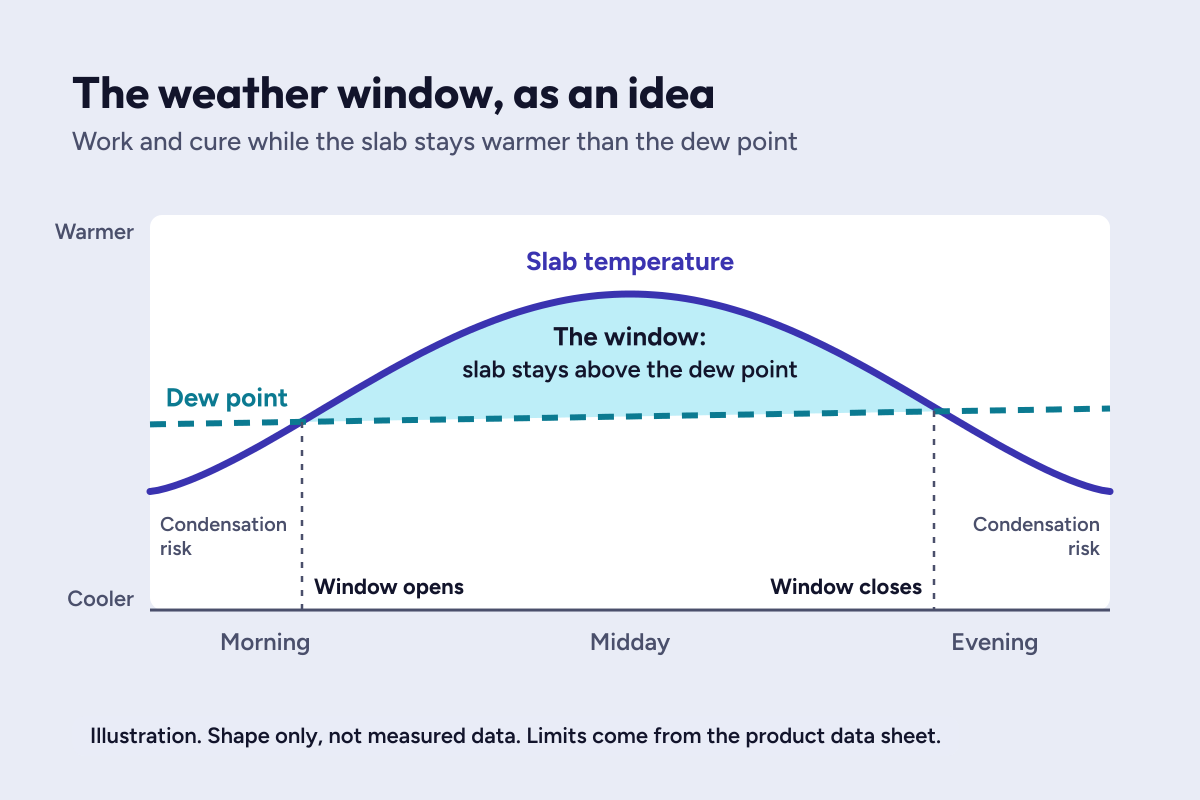
Illustration Polyaspartic garage floor
A fast-curing coat, often used as a clear topcoat. It brings a tighter humidity cap and a short recoat window.
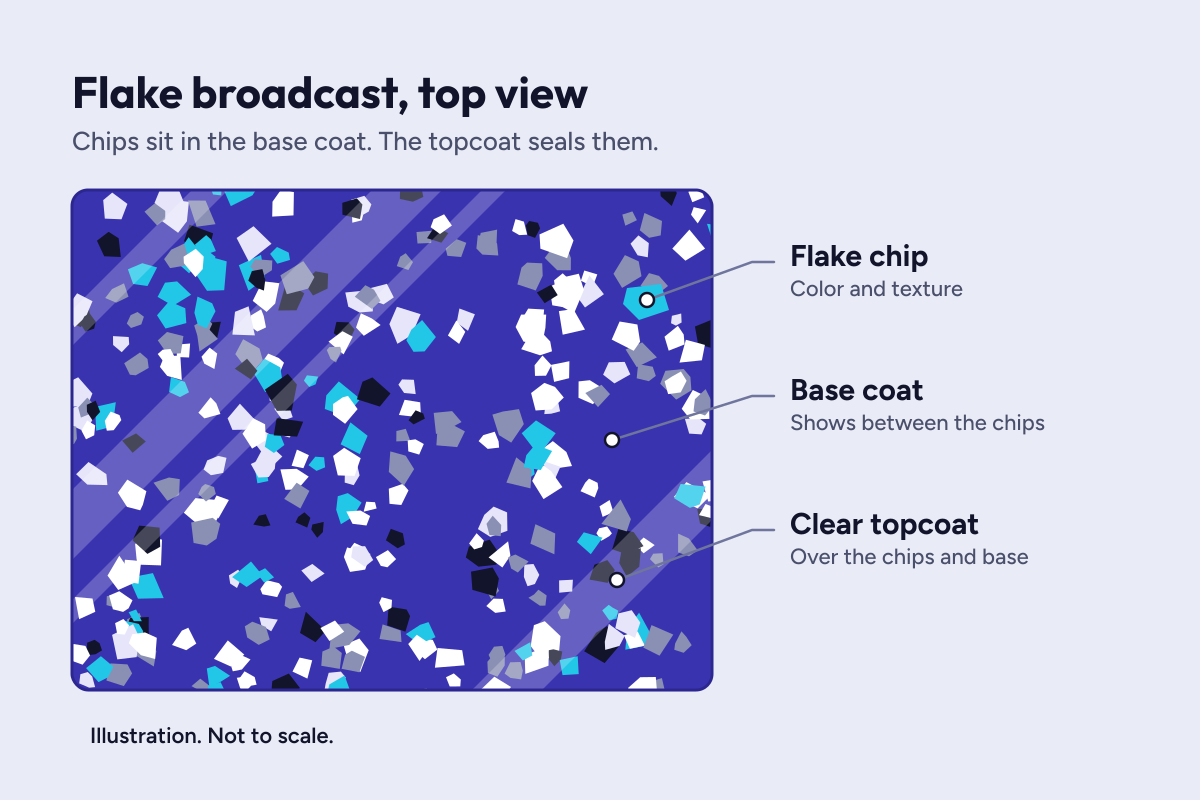
Illustration Flake garage floor
A base coat with colored flakes locked under a clear topcoat. It adds texture and a pattern, and a few more steps.
Guides
Evidence: the facts and sources behind this page
Epoxy garage floor: facts behind this page
As of October 18, 2026
| Fact | Value | Source |
|---|---|---|
| Polyaspartic topcoat data sheet requires substrate at least 5 F above dew point and max ambient RH of 75% during application and curing. | 5 F margin; RH <= 75 F / percent RH | [2] June 10, 2021 |
| Epoxy smooth-finish coating data sheet: max RH 85% during application and cure; substrate at least 5 F (3 C) above dew point; substrate 50-86 F; concrete moisture <= 4% by Tramex meter; no vehicle load until fully cured. | RH <= 85; moisture <= 4; substrate 50-86 percent RH / percent by mass / F | [1] 2026-06 |
| Polyaspartic topcoat at 68 F: foot traffic ~4 h, light traffic ~8 h, full cure ~5 days; marketed for enhanced hot-tire-marking resistance and excellent UV resistance. | 4 h / 8 h / 5 days hours / days | [2] June 10, 2021 |
| Garage-market polyaspartic base coat data sheet: apply 30-90 F, tack-free 2-4 h, vehicles after 24 h at 72 F / 50% RH, recoat 2-12 h, UV stable. | vehicles 24 h hours | [12] 2025 (Version 1; Rev 11/21) |
| Ground moisture can move up through slab-on-grade concrete; a plastic sheet directly under the slab is the recommended barrier, and Building Science argues Florida slabs fare better than California's because of that practice. | n/a | [3] May 26, 2008 |
| Florida s. 489.117(4)(a) lists painting and flooring among scopes that do not require a contractor license (list is non-exhaustive). | no state contractor license for flooring scope | [11] 2026 |
Sources
- Sikafloor-261 CA product data sheet (manufacturer, Canadian edition), 2026-06
- Sikafloor-515 polyaspartic topcoat data sheet (manufacturer), June 10, 2021
- Building Science Corporation, BSI-003 Concrete Floor Problems (Lstiburek), May 26, 2008
- Bob Vila, Everything to Know About Polyaspartic Floor Coating Cost (editorial), January 31, 2024
- Thumbtack, 2026 Epoxy Garage Floor Cost, July 1, 2026
- How Much Does Epoxy Flooring Cost? (This Old House), March 13, 2026
- Garage Floor Replacement Cost (2026 Pricing) (This Old House), April 15, 2026
- How Much Does Epoxy Flooring Cost? [2026 Data] (Angi), August 3, 2026
- How Much Does It Cost to Finish a Floor With Epoxy? (HomeAdvisor), June 20, 2026
- Installer press material on garage floor warranty red flags (installer-side, not independent), 2026-06
- Florida Statutes, section 489.117 (registration and certification), 2026
- ArmorGarage Polyaspartic Floor System TDS (ArmorPoly 80), 2025 (Version 1; Rev 11/21)
Questions people ask
What is the downside of epoxy on concrete?
Epoxy bonds only as well as the slab and the prep allow. Moisture from below, a smooth or sealed surface and a start outside the sheet limits can each make it fail 1. Some epoxy can yellow in direct sun 4. Put the answer to each risk in the written scope.
Can I put epoxy on my garage floor myself?
You can buy kits. Installers say thin kit coats peel more often, but we found no independent data on that. Check the kit's humidity, dew point and slab moisture limits against your garage first, and read the prep guide.
How long until I can drive on a new epoxy floor?
The epoxy sheet we read says no vehicle load until the coat is fully cured 1. We have no sourced hour count for epoxy yet. Put the wait for cars in your written scope, in hours.
Epoxy or polyaspartic: which fits a Florida garage?
The epoxy sheet we read allows humidity up to 85% 1, and the polyaspartic topcoat sheet allows up to 75% 2. Polyaspartic returns to service sooner. We found no independent test that shows one lasting longer in Florida. See polyaspartic garage floors.
Does coating a garage floor need a permit?
As of October 18, 2026
A coating is usually a finish on an existing slab, but the city pages we read do not name epoxy or floor coatings. Confirm with your building department before you hire anyone. The permit and HOA guide lists what each city page says.